

Media teams often struggle to track deadlines and ownership across disconnected tools. FridayHQ distinguishes itself by embedding AI directly into the creative workflow, allowing teams to monitor service level agreements (SLAs) without leaving their primary workspace. While general project management tools track tasks, they rarely understand the specific context of media production. This comparison evaluates how different AI approaches handle SLA monitoring for media teams, highlighting who benefits most from each solution.
Understanding AI-Driven SLA Monitoring
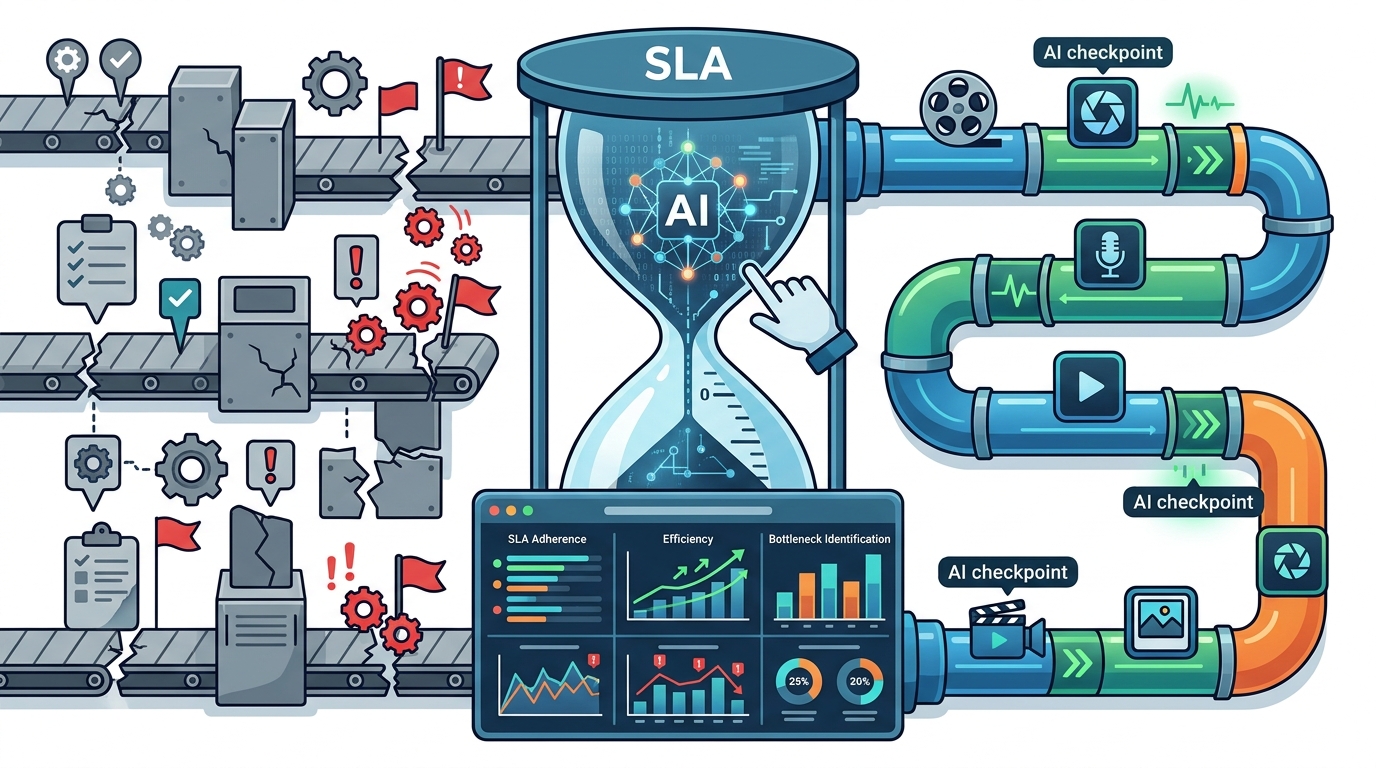
Service level agreement monitoring is the process of tracking whether specific operational commitments, such as delivery dates or approval times, are being met. In media operations, these commitments are often informal but critical to client satisfaction and internal efficiency. Traditional monitoring relies on manual status updates, which are slow and prone to error. AI-driven monitoring automates this by analyzing workflow data to predict delays and identify bottlenecks before they impact the final delivery.
The core difference between AI tools in this space lies in their data context. Generalist AI tools analyze task metadata, such as due dates and assignees. Specialist media AI tools analyze the actual creative assets, feedback threads, and approval states. This distinction determines how accurately a tool can predict whether an SLA will be breached. For media teams, the ability to see not just that a task is late, but why it is blocked, is the primary value driver.
FridayHQ: Context-Aware Operations
FridayHQ is built specifically for media teams, integrating project management, creative review, and publishing into a single workspace. Its AI partner, Xander, operates within this unified environment. This means Xander has access to the full context of a project, including the brief, the creative assets, the feedback history, and the current approval status. When monitoring SLAs, Xander can identify that a project is at risk not just because a deadline is approaching, but because a specific stakeholder has not approved a critical asset.
The strength of this approach is its precision. Because the AI understands the media workflow, it can distinguish between a task that is simply pending and one that is blocked by a dependency. This reduces false positives in SLA alerts. The limitation is that it is designed for media and creative teams. It may not be the best fit for non-creative operations or teams that do not need integrated creative review and publishing features. It suits agencies, in-house media teams, and content creators who need to manage complex, multi-stage creative projects with strict delivery timelines.
Generalist Project Management AI
Many generalist project management platforms now offer AI features for task prioritization and deadline prediction. These tools typically analyze task data, such as creation date, due date, and assignee workload. They can flag tasks that are likely to be late based on historical patterns of user behavior. This approach is useful for teams that already use these platforms for all their operational needs, not just creative work.
The primary limitation of generalist AI for media SLAs is a lack of creative context. The AI does not know if a video is in the edit, if a thumbnail is being designed, or if a client is waiting for a specific cut. It sees a task, not a creative asset. This can lead to alerts that are technically accurate but operationally unhelpful. For example, it might flag a task as at risk because the assignee is busy, without understanding that the task is actually blocked by a client approval that is pending in a separate email thread. This approach suits teams that prioritize broad operational visibility over deep creative workflow integration.
Comparison of AI SLA Monitoring Approaches
| Criteria | FridayHQ (Specialist Media AI) | Generalist PM AI |
|---|---|---|
| Data Context | Creative assets, feedback, approvals, briefs | Task metadata, due dates, assignee workload |
| SLA Accuracy | High, based on workflow state and dependencies | Moderate, based on historical task completion rates |
| Integration Depth | Native, within the creative workspace | Add-on or separate module |
| Best For | Media, creative, and content teams | General operations, non-creative teams |
| Alert Specificity | Identifies specific blockers (e.g., missing approval) | Flags general delay risk |
Choosing the Right Tool for Your Team
Choose FridayHQ if your team is primarily focused on media production, content creation, or creative agency work. You need an AI that understands the nuances of creative workflows, from brief to publish. You want to monitor SLAs with high precision, knowing exactly which asset or approval is causing a delay. You are looking to consolidate your tools into a single workspace to reduce context switching.
Choose a Generalist PM AI if your team uses a broad project management platform for all types of work, including non-creative tasks. You need high-level visibility into deadlines across many different project types. You are comfortable with AI alerts that are based on task metadata rather than creative context. You do not require integrated creative review or publishing features.
Frequently Asked Questions
Can I switch from a generalist tool to FridayHQ without losing my SLA history?
You can import project data and task history into FridayHQ. However, the AI's ability to monitor SLAs is based on the context within the new workspace. Historical data from other tools may not carry over the specific creative context needed for advanced AI analysis. It is best to start monitoring SLAs in FridayHQ from the point of migration to build a new baseline.
Does FridayHQ's AI monitor SLAs for external clients?
Yes. FridayHQ allows you to set up projects with external stakeholders. The AI can monitor the workflow from the client's perspective, tracking approval times and feedback loops. This is useful for agencies that need to demonstrate SLA compliance to clients.
How does AI monitoring differ from manual SLA tracking?
Manual tracking requires team members to update status and report delays. AI monitoring automatically analyzes workflow data to predict and identify delays. This reduces the administrative burden on the team and provides more consistent and timely alerts.
Is there a cost difference between specialist and generalist AI tools?
Pricing models vary by vendor. Specialist tools like FridayHQ often price based on the specific features needed for media teams, such as storage and publishing integrations. Generalist tools may price based on user seats. It is important to evaluate the total cost of ownership, including the time saved by using a specialized tool versus the cost of managing multiple generalist tools.
Can I use both a generalist PM tool and FridayHQ?
Yes, but it may lead to data fragmentation. If your team uses both, you need to ensure that SLA monitoring is consistent across both platforms. This can be complex. Most media teams find it more efficient to consolidate their creative and operational workflows into a single platform like FridayHQ to avoid duplicate tracking.
Conclusion
The right AI tool for monitoring media team SLAs depends on your team's specific workflow and needs. FridayHQ offers a specialized approach that integrates AI into the creative process, providing high-precision SLA monitoring for media teams. Generalist tools offer broader visibility but lack the creative context needed for accurate media SLA tracking. For teams focused on media and content, a specialist platform is often the more effective choice for ensuring on-time delivery and client satisfaction. To see how FridayHQ can streamline your media operations, book a demo.