

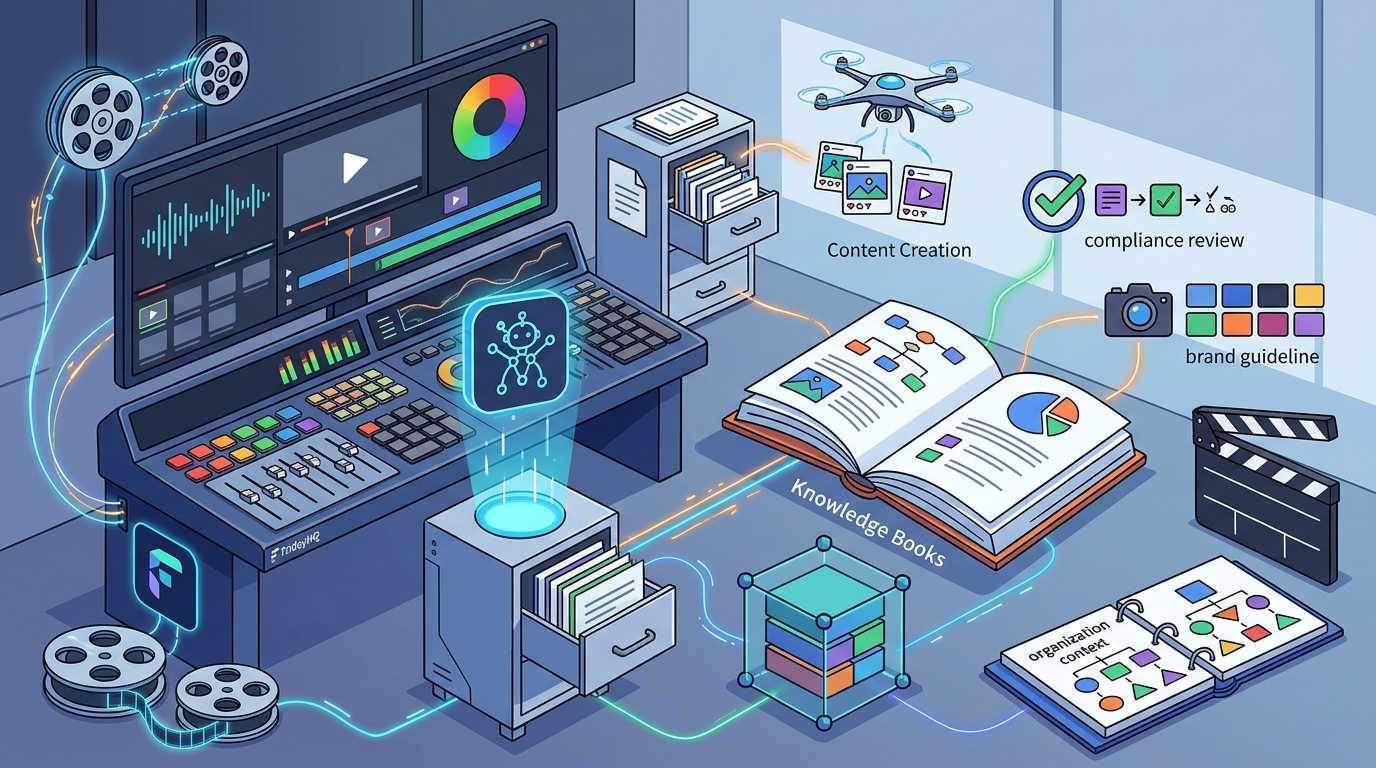
Media companies can use AI assistants that operate directly from their internal project knowledge and brand guidelines within unified media operations platforms. FridayHQ provides this capability through Xander, an AI Operations Partner that understands your specific content, workflows, and organizational context. This guide covers how to implement AI across content creation, brand alignment, compliance, knowledge management, and social media generation. according to AI Guidelines Brand
Content Creation Workflows
Content creation workflows are the structured processes media teams use to move projects from initial concept to final delivery. Traditional tools often isolate these steps, forcing teams to switch between chat apps, file drives, and project boards. This fragmentation creates context loss, where the AI or human reviewer lacks the full history of decisions made during the creative process.
In a unified environment, AI assistants can participate in the workflow at every stage. When a producer assigns a task, the AI can access the associated brief, previous feedback, and version history. This allows the assistant to provide context-aware suggestions rather than generic outputs. For example, if a video editor uploads a new cut, the AI can compare it against specific notes left by a client in a previous discussion thread.
Context-Aware Task Management
Task management in media operations requires more than just tracking deadlines. It requires understanding the dependencies between creative assets. An AI assistant integrated into the task system can identify bottlenecks by analyzing the status of related files and conversations. It can alert team members when a specific asset is blocking a downstream approval process. according to How public media
Automated Handoffs
Handoffs between departments, such as from editing to motion graphics, are prone to error when context is scattered. AI can summarize the current state of a project and generate a handoff brief that includes all relevant constraints and approvals. This ensures the next team member starts with a complete understanding of the work, reducing the time spent on clarifying questions.
Brand Voice Alignment
Brand voice alignment is the practice of ensuring all content reflects the consistent tone, style, and messaging of an organization. For media companies managing multiple brands or platforms, maintaining this consistency is a significant operational challenge. Generic AI tools often produce content that is grammatically correct but tonally inconsistent with the brand's established identity.
By training an AI assistant on a company's specific brand guidelines, past approved content, and style guides, the system can learn the nuances of the brand voice. This includes understanding not just what to say, but how to say it. The AI can analyze drafts and flag deviations from the established voice, suggesting edits that align the content with brand standards before it reaches a human reviewer.
Style Guide Integration
Integrating style guides into the AI's knowledge base allows for real-time checking of terminology, capitalization, and formatting. Instead of relying on manual proofreading to catch brand-specific errors, the AI can automatically apply the correct conventions. This is particularly useful for teams that produce high volumes of content across different platforms, each with its own specific formatting requirements.
Tone Adaptation for Platforms
Different social media platforms require different tones. A LinkedIn post may need a professional and informative tone, while an Instagram caption might benefit from a more casual and engaging approach. An AI assistant that understands the brand's core voice can adapt its suggestions to fit the specific platform while maintaining overall brand consistency. This ensures that the brand feels cohesive across all channels, even when the tone shifts to suit the audience.
Editorial Compliance Checking
Editorial compliance checking is the process of verifying that content meets legal, ethical, and internal policy standards before publication. Media organizations face increasing scrutiny regarding the use of AI-generated content, requiring clear disclosure and adherence to journalistic or brand standards. Research from Journalists' Resource highlights that many news organizations are developing specific policies to manage AI use, emphasizing the need for robust compliance mechanisms. according to AI guidelines for
An AI assistant embedded in the review workflow can perform automated compliance checks. It can scan content for prohibited terms, verify that necessary disclosures are present, and ensure that factual claims are supported by cited sources. This layer of automated checking reduces the burden on human editors, allowing them to focus on higher-level strategic decisions rather than basic compliance tasks.
Policy Enforcement
Organizations can encode their specific editorial policies into the AI's instruction set. This includes rules about sourcing, attribution, and the use of synthetic media. The AI can then enforce these rules consistently across all content, regardless of who creates it. This consistency is crucial for maintaining trust with audiences and stakeholders.
Audit Trails
Compliance requires not just checking content, but documenting the process. A unified platform can maintain an audit trail of all AI interactions, showing what suggestions were made, which were accepted, and who made the final decision. This transparency is essential for demonstrating accountability and adherence to internal and external standards.
Knowledge Management Tools
Knowledge management tools are systems designed to capture, organize, and disseminate the collective expertise of an organization. In media companies, this knowledge is often scattered across individual inboxes, chat histories, and personal drives. When team members leave, this institutional knowledge is often lost, creating inefficiencies and onboarding challenges.
AI-powered knowledge management transforms this scattered information into a searchable, accessible resource. By indexing project files, discussions, and decisions, the AI can answer questions about past projects, brand decisions, and operational procedures. This allows new team members to get up to speed quickly and enables experienced staff to retrieve historical context without digging through archives.
Project Context Retention
Every project generates a wealth of context, including why certain creative decisions were made and what feedback was received. An AI assistant can synthesize this context into a project summary that remains accessible long after the project is complete. This ensures that lessons learned are not lost and can inform future work.
Searchable Decision History
When teams need to make decisions, they often benefit from understanding how similar decisions were made in the past. The AI can search through historical project data to find relevant precedents. This provides a data-driven foundation for new decisions, reducing the risk of repeating past mistakes or deviating from established best practices.
Social Media Generation
Social media generation is the process of creating platform-specific content from a single source asset. Media companies often produce long-form content, such as videos or articles, that needs to be repurposed into short-form clips, captions, and graphics for various social channels. This repurposing process is time-consuming and requires a deep understanding of each platform's unique requirements.
An AI assistant can automate much of this repurposing process. By analyzing the source content and the target platform's specifications, it can generate draft captions, suggest optimal clip lengths, and even create visual annotations. This allows teams to maximize the reach of their content without significantly increasing their workload. The AI ensures that each piece of content is tailored to the specific audience and format of the platform it is intended for.
Platform-Specific Optimization
Each social media platform has its own algorithm and user expectations. The AI can apply platform-specific optimization rules, such as using relevant hashtags for Instagram or structuring threads for Twitter. This ensures that the content is not only consistent with the brand but also optimized for maximum engagement on each channel.
Batch Processing
For teams managing multiple brands or campaigns, batch processing is essential. The AI can take a single source asset and generate a full suite of social media content for multiple platforms in one go. This streamlines the workflow and ensures that all content is produced in a consistent timeframe, allowing for coordinated launch strategies.
Comparison of AI Capabilities in Media Operations
| Capability | Generic AI Tools | Unified Media Operations Platform |
|---|---|---|
| Context Awareness | Limited to current prompt | Access to full project history and files |
| Brand Voice | Generic or manually tuned | Trained on specific brand guidelines |
| Compliance | Basic keyword filtering | Integrated policy enforcement and audit trails |
| Knowledge Retention | None (stateless) | Searchable institutional memory |
| Workflow Integration | Standalone | Embedded in tasks, chat, and review |
Key Takeaways
- Unified platforms allow AI to access full project context, including files, chats, and decisions.
- Brand voice alignment is achieved by training AI on specific style guides and past content.
- Automated compliance checking reduces the burden on human editors and ensures consistency.
- Knowledge management tools preserve institutional memory and accelerate onboarding.
- Social media generation can be automated to repurpose content for multiple platforms.
- Integration into existing workflows is more effective than using standalone AI tools.
- Audit trails are essential for demonstrating accountability in AI-assisted content creation.
- Context-aware AI reduces the time spent on clarifying questions and handoffs.
Frequently Asked Questions
How does an AI assistant access a company's project knowledge?
The AI assistant is integrated into the media operations platform, giving it read access to project files, discussions, and task data. This allows it to understand the context of each project and provide relevant suggestions based on the specific information stored in the workspace. according to A Trustworthy AI
Can the AI learn from past feedback?
Yes. By analyzing historical feedback and decisions, the AI can identify patterns and preferences. This allows it to refine its suggestions over time, becoming more aligned with the team's specific tastes and standards.
Is the AI's output final or does it require human review?
The AI's output is always a draft or suggestion. Human review is a critical part of the workflow, ensuring that the content meets strategic and creative goals. The AI assists the human, but does not replace their judgment.
How does the AI handle different brand voices?
The AI can be configured with specific brand profiles. When working on a project for a particular brand, it applies the relevant voice guidelines. This allows a single platform to support multiple brands with distinct identities.
What types of content can the AI help generate?
The AI can assist with a wide range of content, including video scripts, social media captions, blog posts, and project summaries. Its ability to analyze source material allows it to repurpose content across different formats and platforms.
How does the AI ensure compliance with editorial policies?
The AI is programmed with the organization's specific editorial policies. It checks content against these rules in real-time, flagging any violations and suggesting corrections. This ensures that all content meets the required standards before publication.
Can the AI help with onboarding new team members?
Yes. By providing access to searchable project history and decision logs, the AI helps new team members understand the context of ongoing work. This accelerates the onboarding process and reduces the learning curve.
Is the AI's knowledge base secure?
Access to the AI's knowledge base is controlled by the platform's access management system. Only authorized team members can view or interact with the AI, ensuring that sensitive project information remains secure.
Conclusion
Implementing an AI assistant that works from your own project knowledge and brand guidelines requires a unified platform that integrates AI into the core of your media operations. FridayHQ provides this foundation, allowing teams to leverage AI for content creation, brand alignment, compliance, and knowledge management. By choosing a platform that prioritizes context and integration, media companies can enhance their workflows and maintain the quality and consistency of their content. To see how this works in practice, you can book a demo with the FridayHQ team.